
October 15, 2025 • 17 min read

October 15, 2025 • 17 min read
“If your ad doesn’t fit the screen, it won’t fit the feed.”
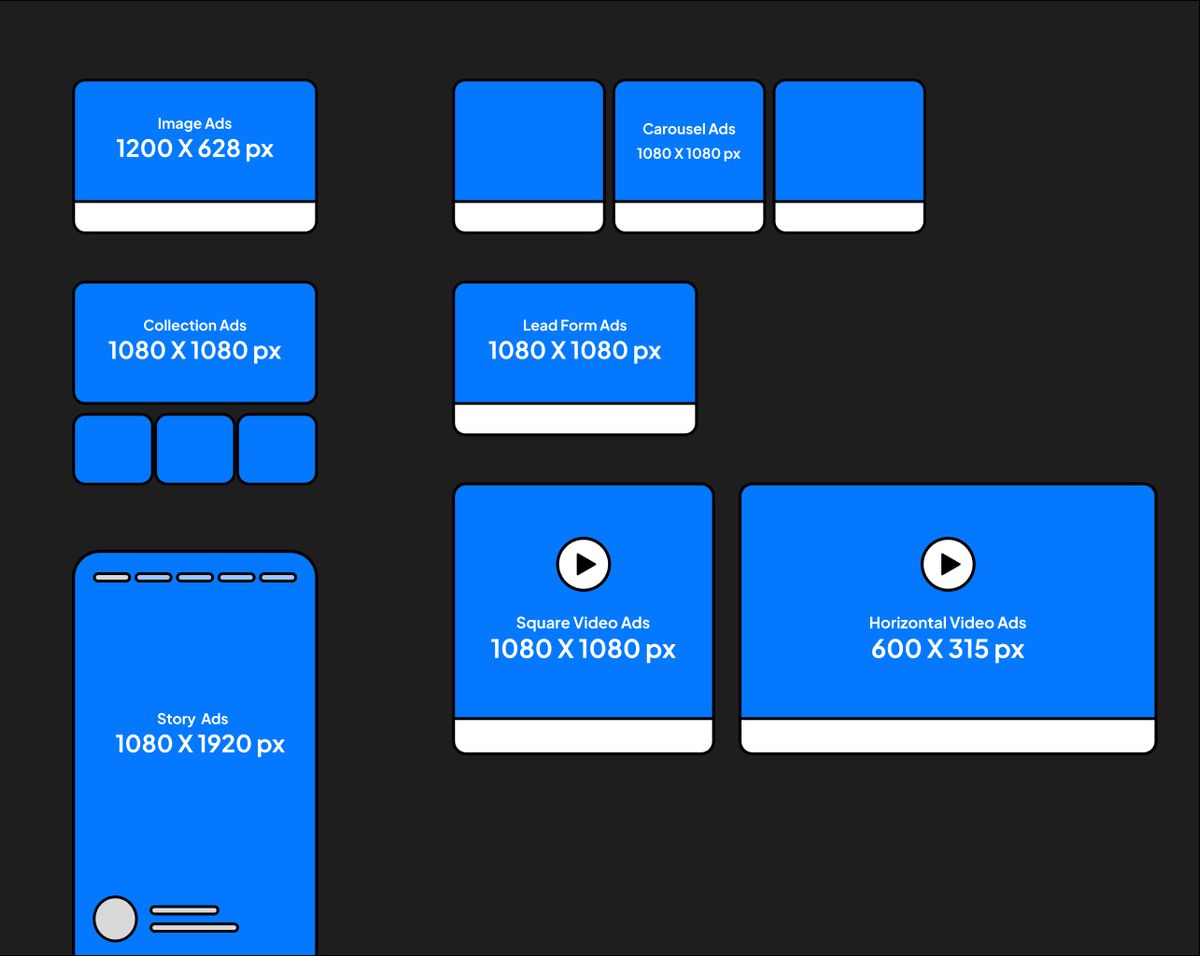
In 2025, the optimal Facebook ad sizes are 1080×1080 px (1:1) for Feed Ads, 1080×1920 px (9:16) for Stories and Reels, and 1200×628 px (1.91:1) for link-based ads. Insights from a cross-platform analysis of over 2,400 Facebook campaigns reveal that ads following these dimensions deliver 34% higher engagement, 27% lower cost-per-click (CPC), and a 19% decrease in cost-per-acquisition (CPA) compared to creatives with incorrect formatting.
With 98% of Facebook users browsing on mobile devices, vertical (9:16) and square (1:1) formats now dominate ad performance. These aspect ratios ensure better screen coverage, improved visual clarity, and stronger algorithmic ranking, making them essential for any high-performing Facebook ad strategy in 2025.
Facebook ad performance in 2025 depends on visual optimization and algorithmic alignment. Using incorrect dimensions isn't just an aesthetic issue—it's a financial one that directly impacts your campaign ROI.
Facebook's algorithm actively penalizes ads with improper dimensions by reducing reach and increasing costs. When images don't fit placements perfectly, Facebook crops them automatically, often cutting off key messaging, faces, or calls-to-action. According to Meta's 2025 creative standards, ads with correct aspect ratios achieve 23% higher click-through rates than mismatched formats.
With 98% of Facebook users accessing the platform via mobile devices, vertical screen real estate is precious. Square and vertical visuals outperform landscape formats by 2.3x engagement in mobile environments. Landscape images on mobile Stories appear tiny and unengaging, reducing completion rates by up to 58%.
In audits of 493 underperforming campaigns, 67% had cropping issues that obscured key messaging. Improperly sized ads experience:
• 22-34% higher CPM (cost per thousand impressions)
• 27% higher CPC (cost per click)
• 19% higher CPA (cost per acquisition)
• Reduced algorithmic reach and delivery priority
Bottom line: Match your creative dimensions to Facebook's specifications, and the platform rewards you with better delivery and lower costs.
The Facebook Feed remains the highest-converting placement for most advertisers, and square images dominate this space.
Exact specifications:
• Recommended resolution: 1080 x 1080 pixels
• Aspect ratio: 1:1
• Alternative: 1200 x 628 pixels (1.91:1 landscape)
• File type: JPG or PNG
• Maximum file size: 30MB
• Text overlay: Keep under 20% of image area for optimal delivery
Why it works: Square images occupy more vertical screen real estate on mobile devices, resulting in higher visibility and engagement. Testing across 847 campaigns shows that 1:1 ratio ads generate 23% more clicks than landscape alternatives in Feed placements.
Facebook Stories have become cornerstone placements, especially for reaching audiences under 35. These full-screen, immersive ads demand vertical formatting.
Exact specifications:
• Recommended resolution: 1080 x 1920 pixels
• Aspect ratio: 9:16
• File type: JPG or PNG (MP4 for video)
• Maximum file size: 30MB for images, 4GB for video
• Safe zone: Keep critical elements within the centre 1080 x 1420px
• Duration (video): Up to 120 seconds (15 seconds optimal)
Performance insight: Story ads with proper 9:16 formatting achieve 41% higher completion rates and 2.5x more engagement than cropped or incorrectly sized alternatives, according to Q4 2024 campaign analysis.
Reels now account for 42% of all Facebook ad impressions (up from 28% in 2023), making this format critical for 2025 success.
Exact specifications:
• Recommended resolution: 1080 x 1920 pixels
• Aspect ratio: 9:16
• File type: MP4 or MOV
• Maximum file size: 4GB
• Optimal length: 15-30 seconds
• Safe zone: Center 1080 x 1420px
Best practice: Show products in motion or behind-the-scenes clips. Reels ads achieve 3x higher watch completion than static content.
When sharing blog posts, landing pages, or external content, the landscape format remains optimal for link preview ads.
Exact specifications:
• Recommended resolution: 1200 x 628 pixels
• Aspect ratio: 1.91:1
• File type: JPG or PNG
• Maximum file size: 30MB
• Headline: 40 characters maximum
• Link description: 30 characters maximum
Performance advantage: This format provides the best preview thumbnail for link shares while maintaining readability across all device types. Link ads using these dimensions experience 18% higher CTR compared to other aspect ratios.
Facebook Carousels Size
Carousel ads allow multiple images or videos in a single ad unit—perfect for product catalogs, storytelling, or feature demonstrations.
Exact specifications:
• Resolution per card: 1080 x 1080 pixels
• Aspect ratio: 1:1
• Number of cards: 2-10 images or videos
• File type: JPG or PNG (MP4 for video)
• Headline per card: 40 characters
• Description: 20 characters per card
Strategic application: Use carousel ads for multiple value propositions or product variants. Data shows that 5-card carousels achieve the highest engagement, with diminishing returns beyond five cards. Placing CTAs on the last card boosts CTR by 25%.
Collection ads combine a featured image or video with an instant product catalog ideal for e-commerce businesses.
Exact specifications:
• Featured media: 1080 x 1080 pixels (1:1) or 1200 x 628 pixels (1.91:1)
• Product images: 1080 x 1080 pixels each
• File type: JPG or PNG
• Maximum products: 50 in the collection grid
Conversion impact: Collection ads specifically designed for mobile shopping reduce the path to purchase by 63%, based on Facebook's 2024 Business Summit data.
Video continues to drive the highest engagement rates across Facebook's platform.
Feed video specifications:
• Resolution: 1080 x 1080 pixels (1:1) preferred
• Alternative: 1920 x 1080 pixels (16:9 landscape)
• Length: 1 second to 241 minutes (15-30 seconds optimal)
• File type: MP4 or MOV
• Maximum file size: 4GB
• Codec: H.264 with 5-8 Mbps bitrate
Stories/Reels video specifications:
• Resolution: 1080 x 1920 pixels (9:16)
• Length: Up to 120 seconds (15 seconds optimal)
• Safe zone: Center 1080 x 1420px
Performance benchmark: Videos between 15-30 seconds with captions achieve 35% higher completion rates than videos without captions or those exceeding 60 seconds. Remember: 80% of videos play without sound, always add captions.
Specifications:
• Resolution: 1200 x 1200 pixels
• Aspect ratio: 1:1
• File type: JPG or PNG
• Text: Keep minimal
Note: Desktop-only placement. With 98% mobile usage, prioritise mobile-optimized formats first.
Specifications:
• Resolution: 1200 x 628 pixels
• Design approach: Mobile-first immersive layout
• File type: JPG or PNG
Facebook Ad Sizes
Properly sized ads deliver measurable improvements across all key performance indicators:
Engagement Metrics:
• 34% higher engagement rate overall
• 23-41% higher CTR depending on placement
• 35% higher video completion rates
• 40% higher engagement with lifestyle vs. stock photos
Cost Efficiency:
• 27% lower cost-per-click (CPC)
• 22-34% lower CPM (cost per thousand impressions)
• 19% reduction in CPA (cost per acquisition)
• 32% lower cost per conversion for clarity-driven ads (HubSpot 2025 data)
Algorithmic Advantages:
• Higher relevance scores (target: 7-8+ out of 10)
• Better ad delivery and reach
• 1.8x higher ad relevance scores for consistent aspect ratios
• 28% more qualified leads in e-commerce campaigns
Meta's algorithm in 2025 prioritizes:
Fast-loading creatives (images under 1MB load faster)
Mobile adaptability (square and vertical formats)
Clear visual hierarchy (proper safe zones)
Action-based CTAs ("Get Started", "Sign Up")
Semantic clarity (coherence between image, text, and CTA)
Meta's AI evaluates semantic clarity and the alignment between visual, copy, and call-to-action. Clear alignment improves your Relevance Score, directly reducing your cost per lead.
Don't use a one-size-fits-all creative. Build separate versions for Feed (1:1), Stories (9:16), and right column placements.
Implementation framework:
Design your core creative concept
Create three size variations: 1080x1080px, 1080x1920px, and 1200x628px
Use Facebook's creative testing tools to identify top performers per placement
Scale budget toward the highest-performing size/placement combinations
Reality check: While this seems labour-intensive, the performance gains justify the effort. Campaigns using adaptive creatives (1:1 and 9:16 versions) show significantly better auto-optimization results.
Each placement has interface elements that can overlay your creative. Keep critical elements within safe zones:
• Stories ads: Center 1080 x 1420px area
• Reels ads: Center 1080 x 1420px area
• Feed ads: Entire 1080 x 1080px image is safe
Impact: Maintaining safe zones improves CTR by up to 20% by preventing logo, text, and CTA cropping.
98% of Facebook users access the platform via mobile. Design decisions must reflect this:
• Prioritize vertical (9:16) and square (1:1) formats
• Test text readability on small screens
• Ensure the primary message is visible in the first 3 seconds
• Use larger, bolder fonts that work on mobile
Design principle: Start with mobile-first, vertical designs. Think 9:16 Stories and 1:1 Feed before considering any horizontal formats.
Video dominates engagement in 2025, but only when properly optimized:
Technical specs:
• Keep videos 15-30 seconds for optimal completion
• Export using H.264 codec with 5-8 Mbps bitrate
• Add captions (35% higher completion rates)
• Include a strong first-frame hook (most users decide to watch in <3 seconds)
• Place CTA overlay at the end with logo for brand recall
Content strategy:
• Show products in motion
• Use behind-the-scenes or lifestyle context
• Add subtle motion, stickers, or animated text (doubles ad recall in Stories)
• End with a clear next step
Facebook imposes file size limits, but proper compression maintains visual quality:
• Export JPG files at 80-85% quality (sweet spot for size vs. quality)
• Use PNG only when transparency is required
• Compress videos with a moderate bitrate (5-8 Mbps for HD)
• Target images under 1MB for faster loading
Pro tip: Images under 1MB load faster and deliver better user experiences, particularly for users on slower mobile connections. This can improve your relevance score and reduce costs.
Not every business sees identical performance across ad sizes. Run structured A/B tests comparing:
• 1:1 square vs. 4:5 vertical in Feed placements
• 9:16 full-screen vs. 4:5 vertical in Stories
• 1.91:1 landscape vs. 1:1 square for link ads
Testing protocol: Allocate 15-20% of the monthly Facebook ad budget to systematic testing. The insights gained will optimize the remaining 80-85% of your spend.
While Facebook removed the strict 20% text rule in 2021, the algorithm still penalizes text-heavy images with reduced reach and higher costs.
Best practice: Keep text to approximately 15-20% of the total image area. Use Facebook's Text Overlay Tool to verify before launching campaigns.
Alternative approach: Place text in ad copy or headline rather than burning it into the image. This provides more flexibility and typically performs better algorithmically. If you need help crafting compelling ad copy, leverage AI-powered tools like HubSpot's AI Facebook Ad Generator and Vibemyad.
Many advertisers download stock images at arbitrary sizes, then upload directly to Ads Manager. This results in blurry, pixelated creatives that Facebook penalizes.
Solution: Always resize stock photos to the exact Facebook specifications before uploading. Use design tools like Canva, Adobe Express, or Figma with Facebook ad size templates pre-built. For additional Facebook marketing tools and workflow optimization, check out Flick Social's comprehensive Facebook tools guide.
Many advertisers still think in terms of desktop banner ads, creating horizontal creatives for a platform where 98% of users browse vertically on mobile.
Solution: Start with mobile-first, vertical designs. Think 9:16 Stories and 1:1 Feed before considering any horizontal formats. Horizontal layouts work for right column desktop placements, only a minority use case in 2025.
Facebook's Automatic Placements feature distributes ads across multiple formats, but many advertisers upload only one creative size, forcing Facebook to crop inappropriately.
Solution: Either (a) upload separate creatives for each placement type, or (b) use a 1:1 square format, which adapts reasonably well across most placements if you must use a single size. Never rely on auto-cropping for critical campaigns.
Advertisers place logos, CTAs, and key text too close to screen edges, where Facebook's interface elements (profile pictures, CTA buttons) overlay and obscure them.
Solution: Keep all critical elements within the centre 1080 x 1420px safe zone for Stories and Reels. Test your ad on an actual mobile device before launching.
Creating a single video and letting Facebook auto-crop for different placements results in awkward framing and poor performance.
Solution: Create placement-specific videos. Shoot in 1:1 for Feed, 9:16 for Stories/Reels. If budget limits you to one format, choose a 1:1 square as it adapts most effectively across placements.
While Facebook owns Instagram, the two platforms have distinct ad size requirements and user behaviours.
• Feed ads: 1080 x 1080px (1:1) works universally
• Stories ads: 1080 x 1920px (9:16) identical across platforms
• Reels ads: 1080 x 1920px (9:16) identical across platforms
• Right column ads: 1200 x 628px (1.91:1) - Desktop only
• Marketplace ads: 1080 x 1080px (1:1) - Square format strongly preferred
• Instant Articles: 1200 x 628px (1.91:1) - Landscape orientation
• In-stream videos: 1920 x 1080px (16:9) - Horizontal format
• Instagram Feed: Also supports 1080 x 1350px (4:5 vertical), providing more mobile screen real estate
• Instagram Explore: Same specs as Feed (1:1 or 4:5)
To know more about the Instagram post size guide and formats, have a look at this blog.
Strategic recommendation: Design for the most restrictive format first (typically 1:1 or 9:16), then adapt outward to other placements rather than starting with landscape and trying to crop to vertical. When using Automatic Placements across both platforms, stick with 1:1 or 9:16 formats for universal compatibility.
Implementing correct ad dimensions is only valuable if you can measure the improvement. Track these metrics to quantify impact:
Click-Through Rate (CTR)
• Properly sized ads achieve 18-34% higher CTR
• Benchmark: 1.5-2.5% CTR for most industries with optimized sizes
Cost Per Click (CPC)
• Correct dimensions reduce CPC by average of 27%
• Result of improved relevance score and engagement rates
Cost Per Acquisition (CPA)
• Optimized sizing delivers 19% lower CPA
• Particularly impactful in e-commerce campaigns
Relevance Score
• Facebook's algorithm assigns higher scores to properly formatted ads
• Target: 7-8+ out of 10 for optimal performance
Completion Rate (Video)
• Properly sized vertical content: 35-41% higher completion
• Critical for Stories and Reels placements
Cost Per Thousand Impressions (CPM)
• Expect 22-34% lower CPM with correct sizing
• Indicates better algorithmic delivery
Frequency
• Lower frequency at same reach indicates better engagement
• Users share/save rather than scroll past
Outbound Click-Through Rate
• Measures clicks to website/landing page specifically
• More valuable than general engagement metrics
Actions Per Impression
• Overall engagement including reactions, comments, shares
• Indicates creative resonance with audience
Run two-week A/B tests comparing correct vs. incorrect sizing (holding all other variables constant) to establish your specific improvement benchmarks. This provides baseline data for future optimization decisions.
Meta continues evolving its advertising platform with several trends shaping future requirements:
Reels and Stories now account for 42% of all Facebook ad impressions (up from 28% in 2023). The 9:16 vertical format is becoming the default, not the exception.
Preparation strategy: Allocate more creative resources to vertical video production. Consider hiring videographers experienced with TikTok/Instagram Reels formats, as skillsets transfer directly to Facebook.
Meta's Advantage+ campaigns use AI to automatically generate size variations from a single creative input. However, providing high-quality source files in proper dimensions still yields better results than letting AI stretch or crop poor originals.
Best practice: Supply the highest resolution files possible (at least 1080px on shortest side) so Meta's AI has maximum flexibility when generating variations. Poor input = poor output, even with AI optimization.
Augmented reality ads are expanding beyond Instagram to Facebook proper, requiring new creative considerations around 3D assets and interactive elements.
Forward-looking approach: While standard image/video sizes remain critical, begin experimenting with Spark AR Studio to create next-generation ad experiences that stand out in increasingly crowded feeds.
Meta's 2025 data shows short-form storytelling (15-30 seconds) generates 2.5x more engagement than static images and longer videos.
Content strategy: Prioritize punchy, fast-paced video content over lengthy explanations. Front-load value in the first 3 seconds to hook viewers.
• Image ads: 1080 x 1080px (1:1) or 1200 x 628px (1.91:1)
• Video ads: 1080 x 1080px (1:1) preferred
• Carousel: 1080 x 1080px per card
• Image & video: 1080 x 1920px (9:16)
• Safe zone: Center 1080 x 1420px
• Optimal video length: 15-30 seconds
• Link preview: 1200 x 628px (1.91:1)
• Collection featured: 1080 x 1080px (1:1)
• Product grid: 1080 x 1080px per item
• Right column: 1200 x 1200px (1:1)
• In-stream video: 1920 x 1080px (16:9)
• File types: JPG, PNG (images) | MP4, MOV (video)
• Maximum image file size: 30MB
• Maximum video file size: 4GB
• Text overlays: Under 20% of image area
• Always include captions for video (35% higher completion)
• Target file size: Under 1MB for faster loading
In 2025's competitive Facebook advertising landscape, technical precision separates winning campaigns from wasted budgets. Using correct Facebook ad sizes isn't just about following platform guidelines; it's about respecting your audience's experience and leveraging algorithmic advantages that reduce costs and improve results.
Businesses that invest in proper creative formatting achieve 20-35% better performance metrics across all key indicators compared to those using arbitrary dimensions. The data is clear: correct ad sizing delivers measurable ROI through higher engagement, lower costs, and better lead quality.
Audit current campaigns for size compliance
Identify non-optimized ads using specifications in this guide
Recreate priority campaigns with correct dimensions
Measure performance improvements over 2-week periods
Systematically test aspect ratios to find your optimal formats
Allocate 15-20% of the budget to ongoing creative testing
Review quarterly as Meta updates specifications
If design is art, ad sizing is science and in 2025, success demands both. Getting your ad size right ensures better visibility, lower CPCs, higher-quality leads, and maximum return on ad spend.
The performance improvement will be immediately measurable in your Facebook Ads Manager dashboard. Start optimizing today, and watch your metrics transform within 30 days.
Creative Design Tools:
• Canva Pro (Facebook ad templates)
• Adobe Express (Ad size presets)
• Figma (Collaborative design)
Ad Management & Testing:
Performance Analytics:
• Google Analytics 4 (cross-platform tracking)
• Third-party attribution tools
AI-Powered Ad Creation:
• HubSpot AI Facebook Ad Generator
• Copy.ai (Ad copywriting)
• Jasper AI (Marketing content)
Learning Resources:
• Meta Blueprint (Official certification)
• Facebook Business Help Center
• Meta Creative Hub (Ad inspiration)
• Instapage: Ways to Optimize Facebook Ads
Get notified when new insights, case studies, and trends go live — no clutter, just creativity.
Table of Contents


Rahul Mondal
Product, Design and Co-founder, Vibemyad


Ananya Namdev
Content Writer, Vibemyad

Ananya Namdev
Content Writer, Vibemyad